
Table of Contents
ToggleWhy Switch to EPS Panels for Modern Construction?
The construction industry is increasingly exploring building systems that can improve construction speed, reduce structural weight and provide better thermal performance without compromising the requirements of the building. One such technology is the Reinforced EPS Structural Panel System, commonly known as an EPS panel construction system.
EPS panels, or Expanded Polystyrene panels, combine an EPS core with reinforcement and concrete/shotcrete layers to create lightweight building elements. BMTPC documentation describes EPS-based panel systems as modern construction systems that can be used for both load-bearing and non-load-bearing applications, depending on the system and structural design.
For builders, architects and developers looking for an alternative to conventional construction methods, switching to an appropriate EPS panel system can offer advantages in construction speed, thermal insulation, handling and material efficiency.
What Are EPS Panels?
EPS stands for Expanded Polystyrene. In an EPS structural panel system, the EPS core works together with reinforcing steel mesh and concrete/shotcrete to form a composite construction element.
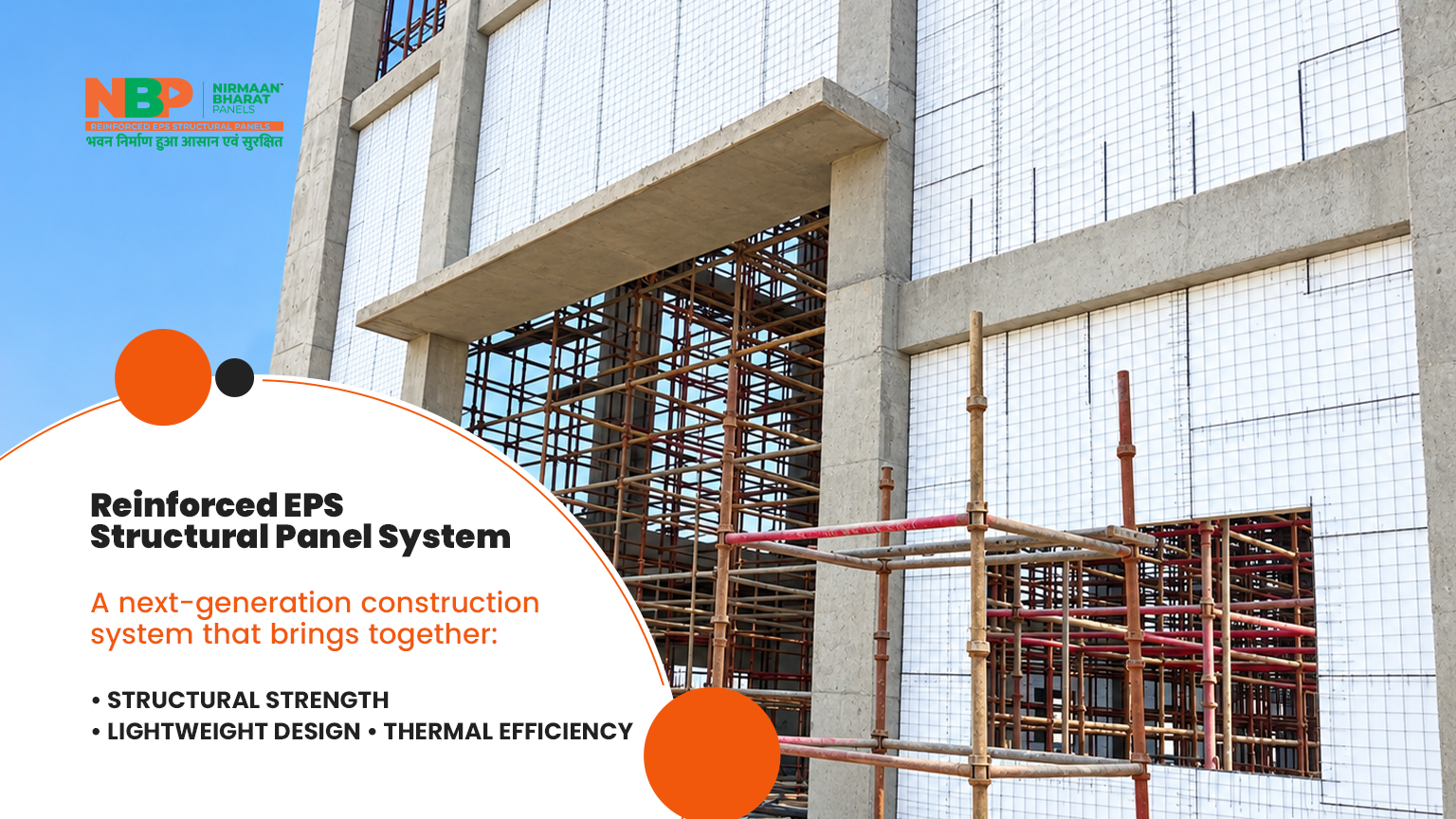
In the Reinforced EPS Structural Panel System, factory-produced EPS panels are reinforced with electro-welded zinc-coated steel meshes connected through cross-connectors. The assembled panels are then concreted on site to form structural elements such as walls and slabs.
This makes EPS panels different from simple foam boards used only for insulation.
EPS Panel Construction Typically Involves:
- Expanded Polystyrene (EPS) core
- Reinforcing steel mesh
- Cross connectors
- Concrete or shotcrete layers
- Finishing/plaster as required by the project
The final system behaves as a composite building element rather than simply being a layer of insulation.
Why Switch to EPS Panels?
Traditional brick-and-block construction remains widely used, but modern construction projects often require faster execution, lighter building components and improved thermal performance.
EPS panel construction addresses several of these requirements through an integrated panel-based approach.
1. Faster Construction
One of the major reasons to consider EPS panels for construction is construction speed.
Factory-produced panels can be transported to the site, positioned and reinforced according to the project design before concrete/shotcrete application.
This can help streamline repetitive wall and slab construction compared with processes that require extensive individual brick/block laying and associated work.
BMTPC’s documentation on EPS panel systems specifically notes faster construction as one of the potential advantages of the technology.
fast construction technology • faster construction system • EPS panel construction • quick construction methods
2. Lightweight Construction
EPS has a much lower density than conventional masonry materials. This makes EPS-based construction systems significantly lighter than many conventional wall assemblies.
A lighter building system can reduce the dead load that needs to be supported by the structural system, subject to structural design.
BMTPC documentation describes EPS panel systems as lightweight construction systems and notes the potential for reduced structural weight.
This makes lightweight EPS panels relevant for residential, commercial, institutional and other construction applications where weight optimization is important.
3. Better Thermal Insulation
Another important advantage of EPS is its thermal insulation capability.
The EPS core creates an insulating layer within the building envelope. BMTPC material on EPS-based panel systems describes low thermal conductivity and thermal insulation as important characteristics of EPS construction.
This can help improve indoor thermal comfort and may contribute to reduced dependence on mechanical cooling, depending on the overall building design, climate, orientation, openings and other envelope components.
For hot regions such as Indore, Ahmedabad and other parts of India, thermal performance can therefore be an important consideration when selecting wall construction systems.
4. Structural Reinforcement + EPS Core
A common misconception is that an EPS panel is simply a foam sheet.
A reinforced EPS structural panel system is considerably different.
The EPS core works together with reinforcing mesh and concrete/shotcrete layers. BMTPC’s description of the Concrewall RESP system notes the use of electro-welded zinc-coated steel meshes and cross connectors, with concrete applied on site to form structural elements.
Therefore, when comparing EPS panels, it is important to evaluate the complete engineered system, not EPS insulation alone.
EPS Panels vs Conventional Construction
Instead of asking whether EPS panels should completely replace every conventional construction method, the better question is:
Where can an EPS panel system provide practical advantages for a particular project?
| Construction Requirement | Conventional Masonry | Reinforced EPS Panel System |
|---|---|---|
| Wall construction | Brick/block based | Factory-made panel based |
| Construction weight | Generally higher | Lightweight system |
| Thermal insulation | Depends on wall assembly | EPS core provides insulation |
| Construction process | Multiple masonry stages | Panel assembly + concrete/shotcrete |
| Material handling | Individual masonry units | Lightweight panels |
| Construction speed | Project dependent | Designed for faster execution |
| Structural design | Conventional structural approach | Requires engineered system/design |
Actual performance, cost and construction duration depend on the project, design, specifications, site conditions and execution quality.
Where Can EPS Panels Be Used?
Depending on the specific engineered system and structural design, EPS panel technology can be considered for various building applications.
Common applications include:
- Residential buildings
- Villas and individual houses
- Commercial buildings
- Institutional buildings
- Schools and educational facilities
- Offices
- Low-rise structures
- Internal and external walls
- Partitions
- Slabs and other structural elements where the system is designed for that application
BMTPC documentation describes EPS-based systems for both load-bearing and non-load-bearing applications, while the particular application must follow the relevant system’s design requirements.
EPS Panels Are Not Just “Thermocol”
People often search for thermocol panels, thermocol construction panels or thermocol wall panels when looking for EPS construction technology.
Technically, EPS means Expanded Polystyrene.
However, a reinforced EPS structural panel should not be confused with an ordinary loose thermocol sheet.
A structural EPS panel system combines the EPS core with reinforcement and concrete/shotcrete to create a designed construction element.
This distinction is especially important when evaluating EPS panel manufacturers in India.
Why Choose a Proper EPS Panel Manufacturer?
The performance of an EPS construction system depends not only on the EPS core but also on the engineering, reinforcement, manufacturing quality, installation and concrete application.
When selecting an EPS panel manufacturer, consider:
- Panel specifications
- EPS density and quality
- Reinforcement configuration
- Steel mesh specifications
- Connection system
- Structural design requirements
- Concrete/shotcrete specifications
- Installation methodology
- Quality control
- Technical documentation
- Project experience
- Applicable certifications/appraisals
For example, BMTPC’s PACS listing identifies Concrewall – Reinforced EPS Structural Panels (RESP System) by NBP Nirmaan Bharat Panels LLP, Indore under item 1070-S/2025.
Switch to EPS Panels with NBP Nirmaan Bharat Panels
NBP Nirmaan Bharat Panels LLP manufactures Reinforced EPS Structural Panel Systems designed for modern construction applications.
The system combines a lightweight EPS core with reinforcement and concrete/shotcrete to create a composite building system.
For projects where faster construction, lightweight construction and thermal insulation are important considerations, EPS panels can be evaluated as an alternative construction technology.
If you are looking for:
EPS Panels in Indore
EPS Panel Manufacturer in Indore
Reinforced EPS Structural Panels
EPS Construction System in India
EPS Wall Panels
Lightweight Construction Panels
EPS Panel House Construction
contact NBP Nirmaan Bharat Panels to discuss your project requirements and suitable panel system.
Frequently Asked Questions
What are EPS panels in construction?
EPS panels are construction panels incorporating an Expanded Polystyrene core with reinforcement and, depending on the system, concrete or shotcrete layers. They are used to create lightweight building elements.
Are EPS panels strong?
A reinforced EPS structural panel system derives its structural performance from the complete composite system, including reinforcement and concrete/shotcrete. Structural design and installation must be carried out according to the applicable system requirements.
Are EPS panels suitable for Indian climate?
EPS provides thermal insulation, which can be useful in hot climatic conditions. However, overall building thermal performance depends on the complete building envelope and design.
Are EPS panels the same as thermocol?
EPS and thermocol are commonly used interchangeably in everyday searches, but a reinforced EPS construction system is not simply a thermocol sheet. It incorporates reinforcement and concrete/shotcrete as part of the engineered system.
Where are EPS panels available in India?
EPS construction systems are available from manufacturers and technology providers across India. NBP Nirmaan Bharat Panels manufactures Reinforced EPS Structural Panels in Indore.
Is EPS panel construction faster than conventional construction?
EPS panel systems are designed to streamline construction through factory-produced panels and on-site assembly. Actual project duration depends on design, project size, site conditions, manpower and execution.