
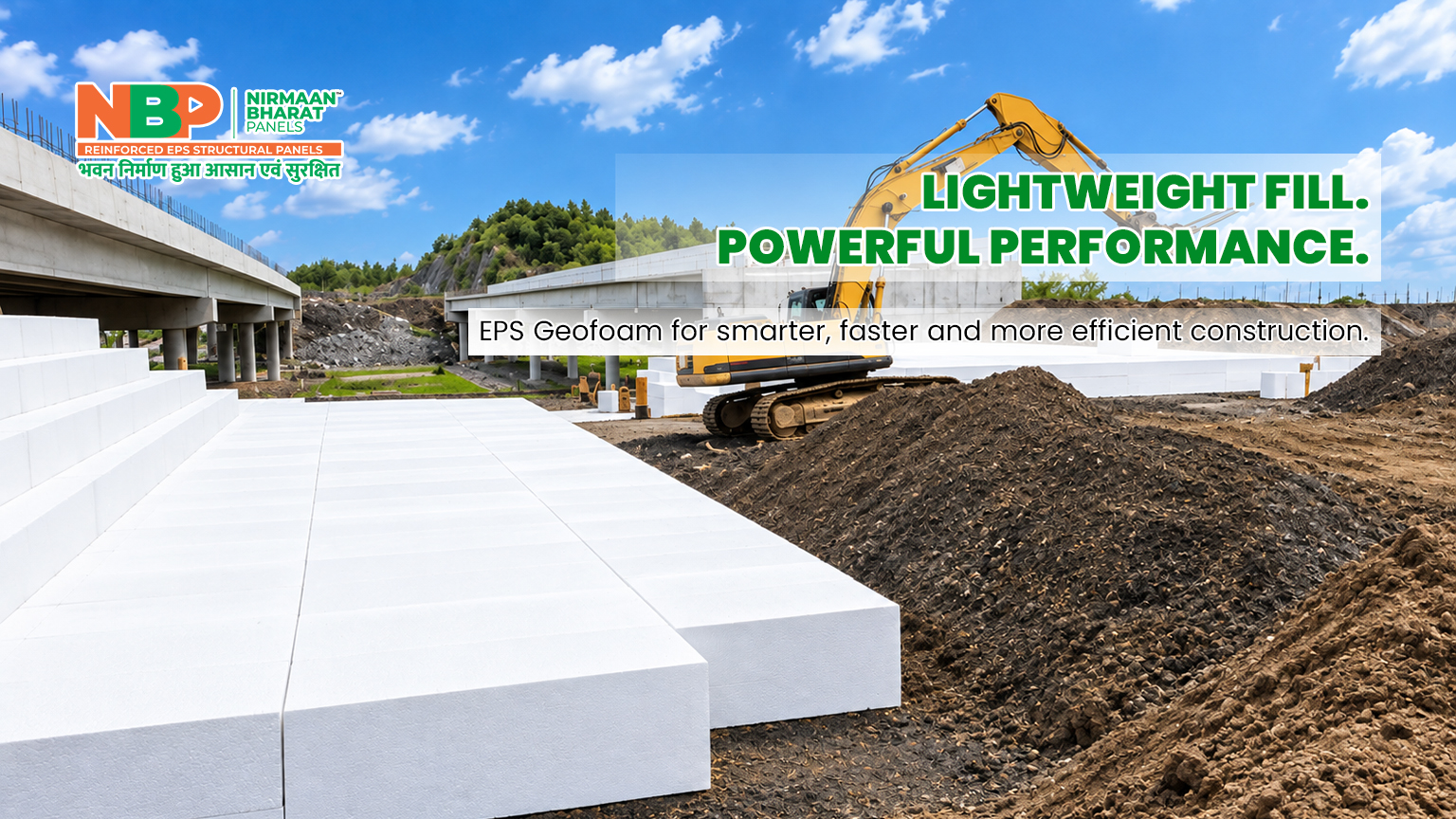
EPS Geofoam is an engineered lightweight fill material made from expanded polystyrene (EPS) and is used in civil engineering and construction applications where reducing the weight of conventional soil or fill is important.
Unlike traditional earth fill, EPS geofoam has an extremely low density while providing useful compressive strength for properly designed applications. This makes it suitable for projects where reducing loads on underlying soil, accelerating construction and simplifying material handling are important considerations.
From road and highway construction to embankments, bridge approaches, slope stabilization and retaining-wall applications, EPS geofoam provides a practical lightweight alternative to conventional fill materials.
Table of Contents
ToggleWhat Is EPS Geofoam?
EPS Geofoam is a rigid, lightweight foam material manufactured from Expanded Polystyrene (EPS). EPS beads are expanded and fused together to form large blocks that can be produced in different dimensions and cut or shaped according to project requirements.
Because of its very low density, EPS geofoam can dramatically reduce the amount of weight placed on underlying ground compared with conventional soil fill. This is particularly useful on sites with soft, weak or compressible soils, where adding large quantities of traditional fill can increase settlement or stability concerns.
Why Use EPS Geofoam?
Traditional soil and aggregate fills can add significant dead load to the ground. EPS geofoam offers a different approach: instead of adding heavy fill, engineers can use a lightweight engineered material to achieve the required elevation or geometry while reducing the load transferred to the underlying soil.
This can be particularly useful where:
- Existing soil has low bearing capacity
- Settlement needs to be controlled
- Construction schedules are tight
- Heavy earthmoving operations are difficult
- Access to the construction area is limited
- Reduced lateral pressure is required behind structures
FHWA documentation identifies EPS geofoam as a lightweight fill option that can reduce vertical stress on foundation soils and help address settlement and stability challenges.
Key Benefits of EPS Geofoam
1. Extremely Lightweight Fill
One of the biggest advantages of EPS geofoam is its very low density compared with conventional soil.
FHWA lists typical EPS geofoam densities in the range of approximately 12–32 kg/m³, depending on the material grade.
This significant weight reduction can help reduce the load imposed on weak or compressible ground.
2. Faster Construction
EPS geofoam blocks are lightweight and can be positioned relatively quickly compared with conventional fill placement and compaction.
Because large quantities of soil do not need to be transported, placed and compacted in the same manner as traditional earth fill, geofoam can help simplify construction operations and shorten schedules in suitable projects.
3. Reduced Load on Weak Soil
Construction over soft or compressible soil can create challenges because conventional fill adds substantial weight.
EPS geofoam provides a lightweight alternative that can significantly reduce the additional vertical stress imposed on the foundation soil. This makes it particularly relevant for soft-ground construction and embankment projects.
4. Easy to Handle and Install
Large EPS geofoam blocks are substantially lighter than conventional construction fill. Depending on the project design and block size, they can be positioned with relatively simple handling equipment and can be cut or shaped to suit the required geometry.
5. Suitable for Complex Construction Conditions
EPS geofoam can be useful where conventional earth filling is difficult because of restricted access, limited right-of-way or challenging ground conditions.
Its use has been documented in highway and bridge projects where construction time and ground loading were important considerations.
Applications of EPS Geofoam
EPS geofoam has applications across several areas of civil engineering and infrastructure construction.
Road & Highway Construction
EPS geofoam can be used as lightweight fill beneath roadways and highway embankments, particularly where conventional fill would place excessive loads on weak underlying soils.
Bridge Approach Fills
Geofoam can be used for bridge approach embankments. Its lightweight characteristics can help reduce loading on foundation soils and can help address differential movement concerns at bridge approach areas when properly designed.
Embankment Construction
EPS geofoam can be used to construct lightweight embankments where reducing the weight of fill is a major project requirement.
Slope Stabilization
Replacing portions of heavy fill with lightweight EPS geofoam can reduce driving forces acting on certain slope systems. FHWA has documented its use in slope rehabilitation projects.
Retaining Wall Applications
EPS geofoam can also be used as lightweight fill behind retaining structures to reduce lateral loads when incorporated into an appropriately engineered system.
Pipeline & Utility Protection
Geofoam can be considered around certain buried infrastructure where reducing the weight of overlying fill is beneficial. Highway guidance identifies pipeline and trench fill as one of its potential applications.
Landscaping & Architectural Landform
EPS geofoam blocks can also be shaped into lightweight forms for creating elevated landscapes, terraces, seating profiles and other constructed landforms.
EPS Geofoam vs Conventional Fill
| Feature | EPS Geofoam | Conventional Soil Fill |
|---|---|---|
| Weight | Extremely lightweight | Relatively heavy |
| Handling | Easy to handle compared with soil | Requires earthmoving equipment |
| Compaction | Does not function as conventional compacted soil | Requires placement and compaction |
| Ground Loading | Significantly reduced | Higher |
| Shaping | Blocks can be cut/shaped | Requires excavation and grading |
| Construction Speed | Can support rapid installation | Often involves multiple filling & compaction stages |
| Typical Use | Engineered lightweight fill | General earthwork and embankment fill |
Important: EPS geofoam is an engineered construction material, not a universal replacement for soil. The appropriate density/grade, protection, drainage, cover system and structural design depend on the specific project requirements.
Why EPS Geofoam Is a Smarter Lightweight Fill Solution
Modern infrastructure projects increasingly require construction methods that address ground conditions, construction time, material handling and project constraints together.
EPS geofoam provides a combination of very low weight, engineered compressive performance and ease of installation, making it a valuable option for suitable civil engineering applications. FHWA guidance recognizes EPS-block geofoam as a lightweight fill material used by transportation agencies, particularly in applications such as embankments and bridge approaches.
When correctly designed and installed, EPS geofoam can help construction teams achieve required elevations and geometries while reducing the amount of heavy fill placed over underlying ground.
EPS Geofoam from Nirmaan Bharat Panels
At Nirmaan Bharat Panels, we provide EPS-based construction solutions with a focus on efficient and modern building practices.
Our EPS Geofoam solution is suitable for projects where lightweight fill is required for applications such as:
- Road and highway construction
- Embankments
- Bridge approach areas
- Slope stabilization
- Retaining structures
- Landscaping and landform development
- Lightweight ground-fill applications
- Infrastructure and civil construction projects
With the right engineering design and installation methodology, EPS Geofoam can help create lightweight, efficient and faster construction solutions.
Lightweight Fill. Powerful Performance.
Build Faster. Build Smarter. with NBP Nirmaan Bharat Panels.
Frequently Asked Questions
What is EPS Geofoam?
EPS Geofoam is a rigid, lightweight material made from expanded polystyrene and used as an engineered fill in civil engineering and construction applications.
Is EPS Geofoam the same as normal EPS?
EPS Geofoam is an engineered EPS product designed for geotechnical fill applications. Its required density and compressive properties are selected according to project requirements.
Where is EPS Geofoam used?
EPS geofoam is used in applications including road construction, highway embankments, bridge approaches, slope stabilization, retaining-wall fills and other lightweight fill applications.
Is EPS Geofoam suitable for soft soil?
It can be suitable for projects involving soft or compressible soils because its very low weight can significantly reduce the additional load placed on the underlying ground. However, suitability must be established through project-specific geotechnical and structural design.
Can EPS Geofoam be cut into different shapes?
Yes. EPS geofoam blocks can be manufactured in different sizes and can be cut or shaped according to project requirements.