
The construction industry is rapidly moving toward faster, lightweight, energy-efficient and durable building solutions. One technology gaining attention for modern construction is Reinforced EPS Structural Panels.
Reinforced EPS panels combine the lightweight and insulating properties of Expanded Polystyrene (EPS) with reinforcement and a cementitious/concrete shell to create a practical wall construction system. Such systems are being used for residential, commercial and industrial applications where speed, thermal performance and durability are important.
For projects such as commercial buildings, industrial facilities, institutional buildings and data center infrastructure, choosing the right wall system can have a significant impact on construction speed, thermal performance and overall building efficiency.
Table of Contents
ToggleWhat Are Reinforced EPS Structural Panels?
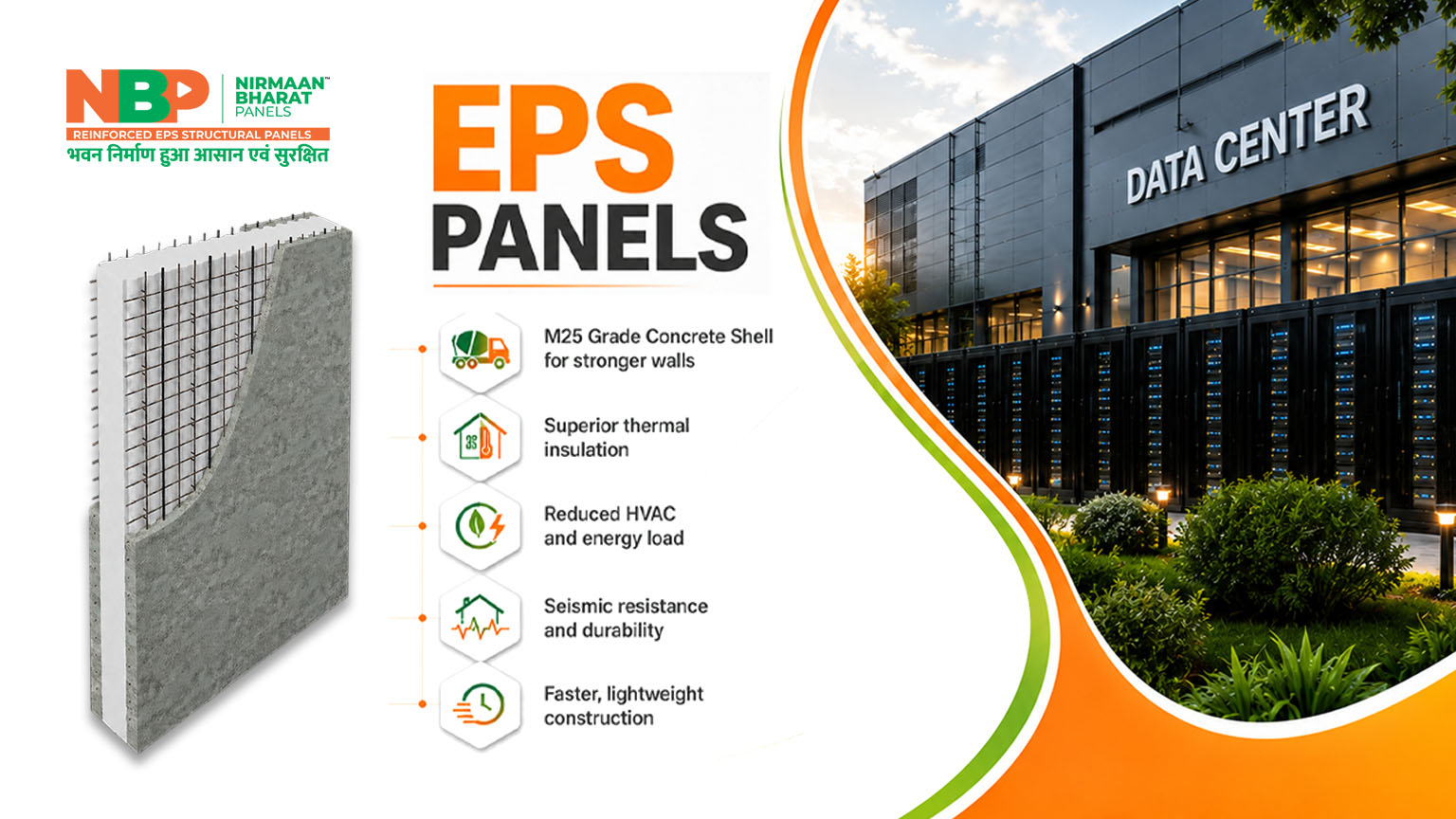
Reinforced EPS Structural Panels are lightweight construction panels consisting of an EPS core combined with reinforcement and a concrete/cementitious outer shell.
The EPS core provides thermal insulation while the reinforced outer layers contribute to the structural strength and durability of the wall system.
Unlike conventional brick-and-block construction, EPS panel technology is designed to provide a combination of:
- Lightweight construction
- Structural strength
- Thermal insulation
- Faster installation
- Energy efficiency
- Durability
- Design flexibility
This combination makes EPS construction panels an attractive solution for modern building projects.
Why Choose EPS Panels for Modern Construction?
1. M25 Grade Concrete Shell for Stronger Walls
The concrete shell provides a robust protective layer around the EPS core. M25 grade concrete can provide the required strength when designed and executed according to project specifications.
The reinforced panel system can therefore offer a strong wall solution while maintaining the lightweight characteristics of EPS.
2. Superior Thermal Insulation
One of the major advantages of EPS construction is its thermal insulation capability.
The EPS core helps reduce heat transfer through the building envelope, which can contribute to improved indoor thermal comfort and reduced dependence on mechanical cooling. Reinforced EPS systems are widely promoted for their combination of insulation and structural performance.
This makes EPS insulated wall panels particularly relevant for India’s varied climatic conditions.
3. Reduced HVAC & Energy Load
Better thermal insulation can help reduce the amount of heat entering or leaving a building.
For facilities with substantial cooling requirements, such as data centers, commercial buildings and industrial facilities, efficient building-envelope design can be an important consideration.
By reducing unwanted heat transfer, insulated wall systems can support more efficient HVAC operation.
4. Seismic Resistance & Durability
Modern buildings require construction systems capable of performing reliably under different environmental and structural conditions.
Reinforced EPS panel systems combine reinforcement with a cementitious/concrete shell, creating a lightweight composite wall system. Reinforced EPS wall systems are also promoted for applications where durability and resistance to environmental stresses are important.
Important: Actual seismic performance depends on engineering design, reinforcement detailing, connections, foundation conditions and applicable structural codes.
5. Faster & Lightweight Construction
One of the biggest advantages of EPS panels for construction is their lightweight nature.
Compared with conventional masonry, lightweight panel systems can simplify handling and installation at the site. Prefabricated panel construction can also help reduce construction time and site disruption when properly planned.
For developers looking for faster construction technology in India, EPS structural panels can be an effective option to evaluate.
EPS Panels for Data Centers & Critical Facilities
Data centers require buildings designed around demanding operational requirements, including temperature control, reliability, security and efficient infrastructure management.
The thermal insulation properties of EPS panels, combined with a reinforced structural wall system, make them worth considering for selected data center and critical-facility applications.
Potential advantages include:
Thermal insulation → Better temperature management → Reduced heat transfer → Potential HVAC efficiency benefits
However, data center projects should always select wall systems based on the complete structural, fire-safety, MEP, acoustic and performance requirements of the facility.
Applications of Reinforced EPS Panels
Reinforced EPS Structural Panels can be considered for a wide range of construction applications, including:
- Residential buildings
- Commercial buildings
- Industrial buildings
- Institutional projects
- Warehouses
- Data centers
- Office buildings
- Prefabricated structures
- Lightweight wall construction
- Partition and enclosure applications
The technology’s lightweight nature, insulation capability and installation flexibility make it suitable for different modern construction requirements.
EPS Panels vs Traditional Construction
Traditional brick-and-block construction remains widely used, but modern projects increasingly look for construction systems that can improve speed, thermal performance and material efficiency.
| Feature | Reinforced EPS Panels | Traditional Masonry |
|---|---|---|
| Construction speed | Faster installation potential | Generally slower |
| Weight | Lightweight | Heavier |
| Thermal insulation | High potential | Depends heavily on wall composition |
| Handling | Easier due to lightweight panels | More material-intensive |
| Construction technology | Modern panel system | Conventional masonry |
| Design flexibility | High | Moderate |
| Energy efficiency | Excellent potential | Depends on construction system |
The actual performance and cost comparison should always be evaluated project-by-project based on specifications, thickness, structural design, labour, transportation and site conditions.
Why Nirmaan Bharat Panels?
Nirmaan Bharat Panels offers Reinforced EPS Structural Panel solutions designed around the requirements of modern construction.
With a focus on strength, thermal insulation, energy efficiency and faster construction, EPS panel technology can provide an alternative approach to conventional wall construction.
Whether you are an architect, builder, contractor, developer or project consultant, selecting the right construction system at the planning stage can help improve project efficiency.
Frequently Asked Questions
What are EPS structural panels?
EPS structural panels are lightweight construction panels that use an Expanded Polystyrene (EPS) core with reinforcement and cementitious/concrete layers to create an insulated wall system.
Are EPS panels suitable for commercial buildings?
Yes. Reinforced EPS panel systems can be considered for commercial, industrial, institutional and residential construction, subject to project-specific structural and performance requirements.
Do EPS panels provide thermal insulation?
Yes. The EPS core provides thermal insulation and helps reduce heat transfer through the wall assembly.
Are EPS panels lightweight?
Yes. EPS is a lightweight material, which makes EPS-based construction systems easier to handle and can support faster installation.
Can EPS panels be used for data centers?
They can be considered for selected data-center applications where the complete wall system meets the project’s structural, thermal, fire, acoustic and MEP requirements.